How to Backtest a Forex Strategy Without Fooling Yourself
How to Backtest a Forex Strategy Without Fooling Yourself
The Purpose of a Backtest
A backtest asks how a precisely defined strategy would have behaved on historical data. Its purpose is not to create a perfect equity curve. It is to reject weak ideas, estimate a realistic range of performance, and understand when a strategy is likely to work or fail.
In-Sample and Out-of-Sample Data
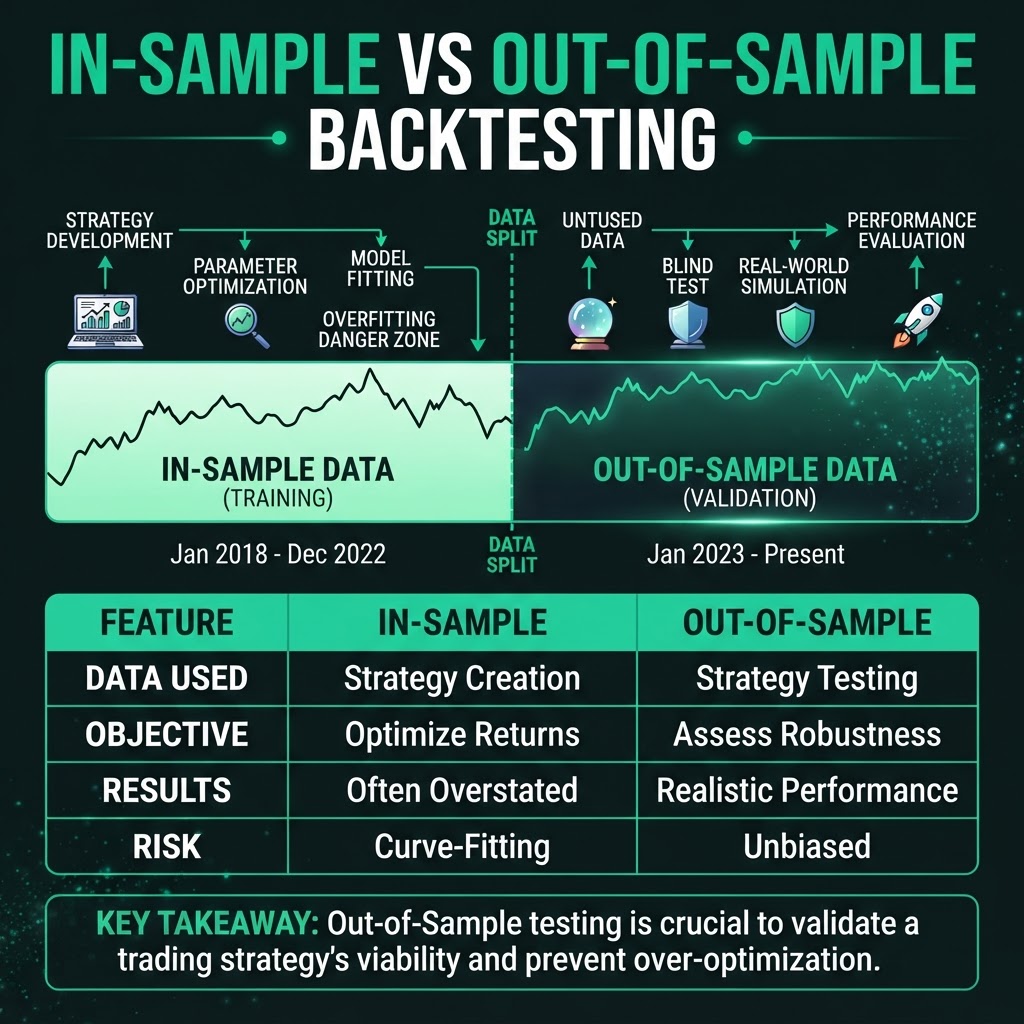
Use one period to develop the rules and a separate untouched period to validate them. The development period is in-sample data. The validation period is out-of-sample data.
If rules are repeatedly changed after viewing the validation results, that period is no longer truly out of sample. Reserve a new segment or use walk-forward testing.
Avoid Look-Ahead Bias
Look-ahead bias occurs when a decision uses information that was unavailable at the simulated entry time. Examples include entering at a candle's open based on its eventual close or using a revised economic value as if it were the original release.
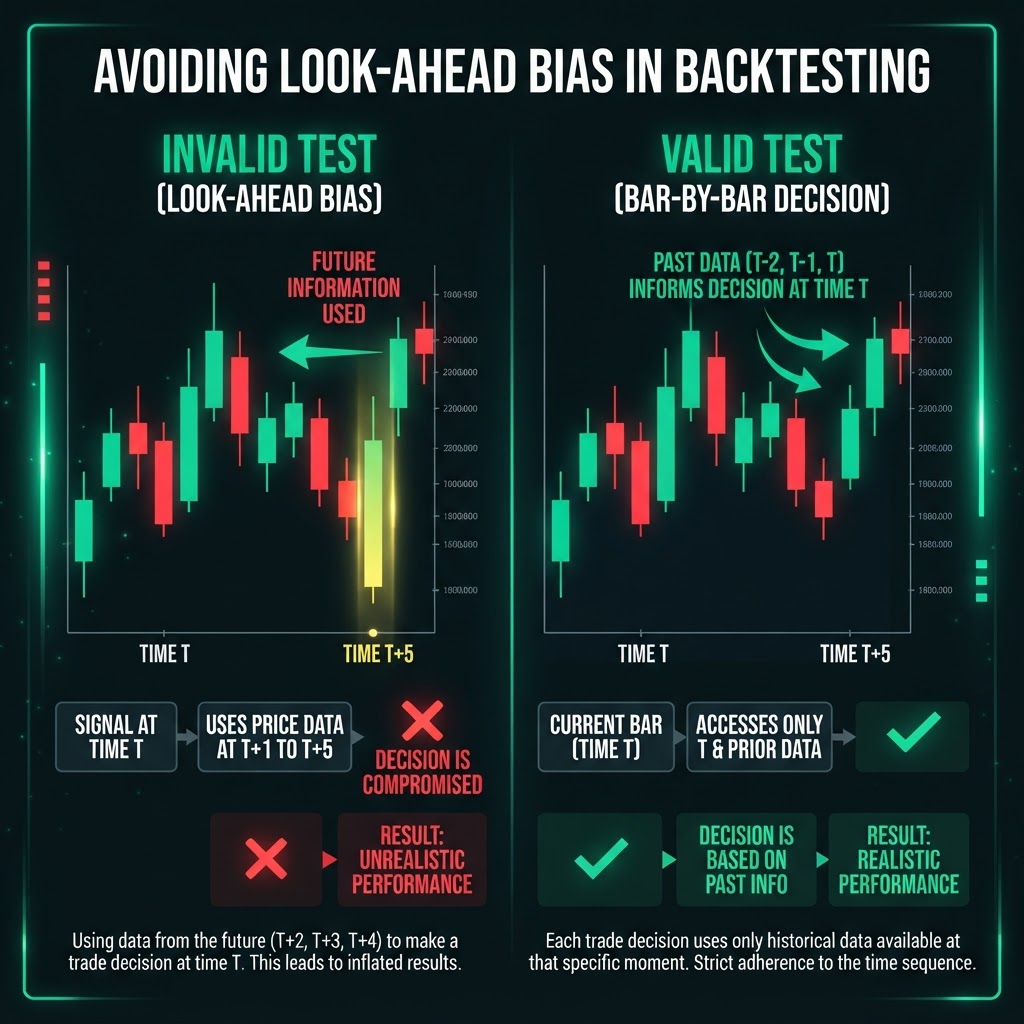
Advance bar by bar. Define exactly when a signal becomes known and assume execution only afterward. Include realistic spread, commission, swap, slippage, and session constraints.
Define Objective Rules
A testable strategy needs unambiguous entries, exits, invalidation, position sizing, market selection, timeframe, and trading hours. Phrases such as strong trend or clean setup must be converted into measurable conditions or consistently scored by a documented manual process.
Metrics That Matter
Net profit alone hides risk. Track expectancy, win rate, average win, average loss, profit factor, maximum drawdown, losing-streak length, trade frequency, and exposure time.
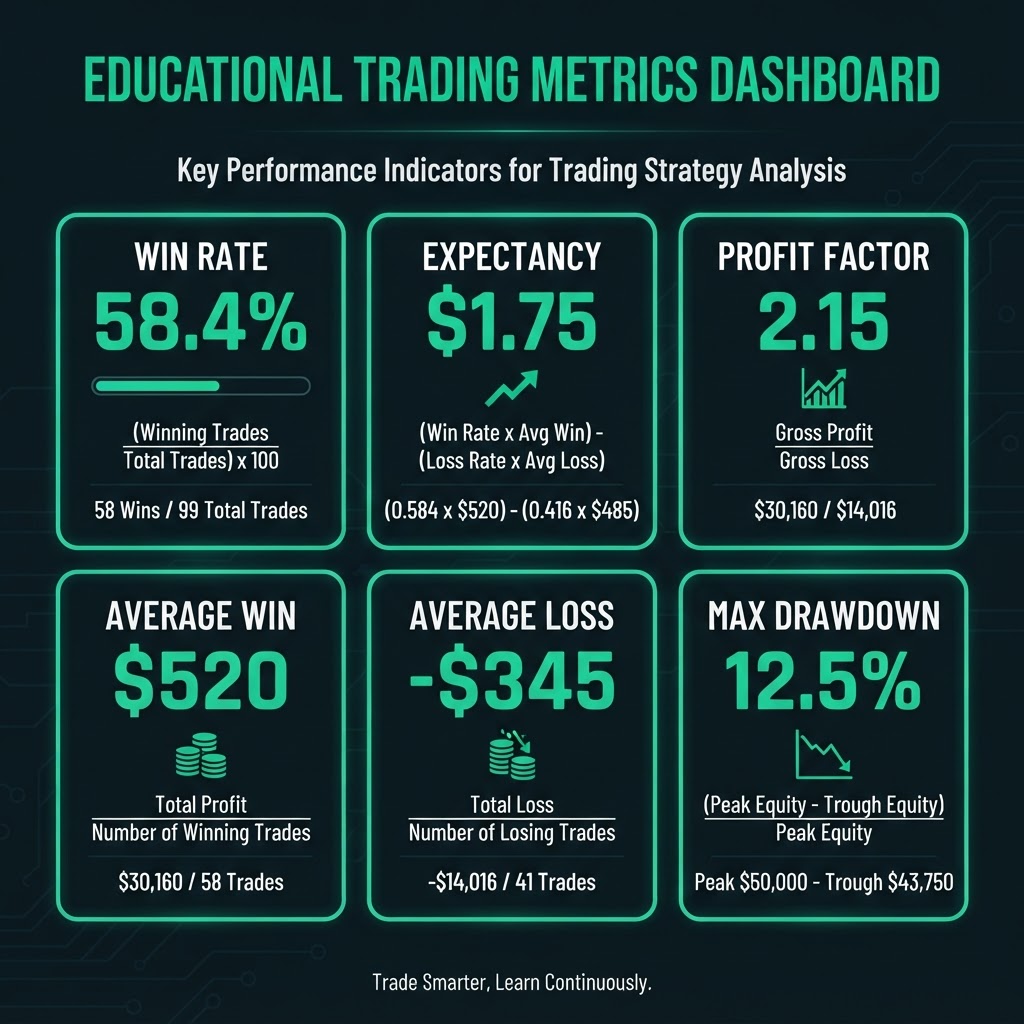
Expectancy can be expressed as:
Expectancy = (Win Rate × Average Win) − (Loss Rate × Average Loss)
Segment the results by year, currency pair, volatility regime, and session. A robust edge should not depend on one exceptional month or one instrument.
Overfitting
Overfitting happens when rules are tailored to historical noise. Warning signs include too many parameters, extremely precise thresholds, and large performance deterioration after small rule changes. Prefer simple economic or behavioral logic and stable performance across nearby settings.
A Reliable Workflow
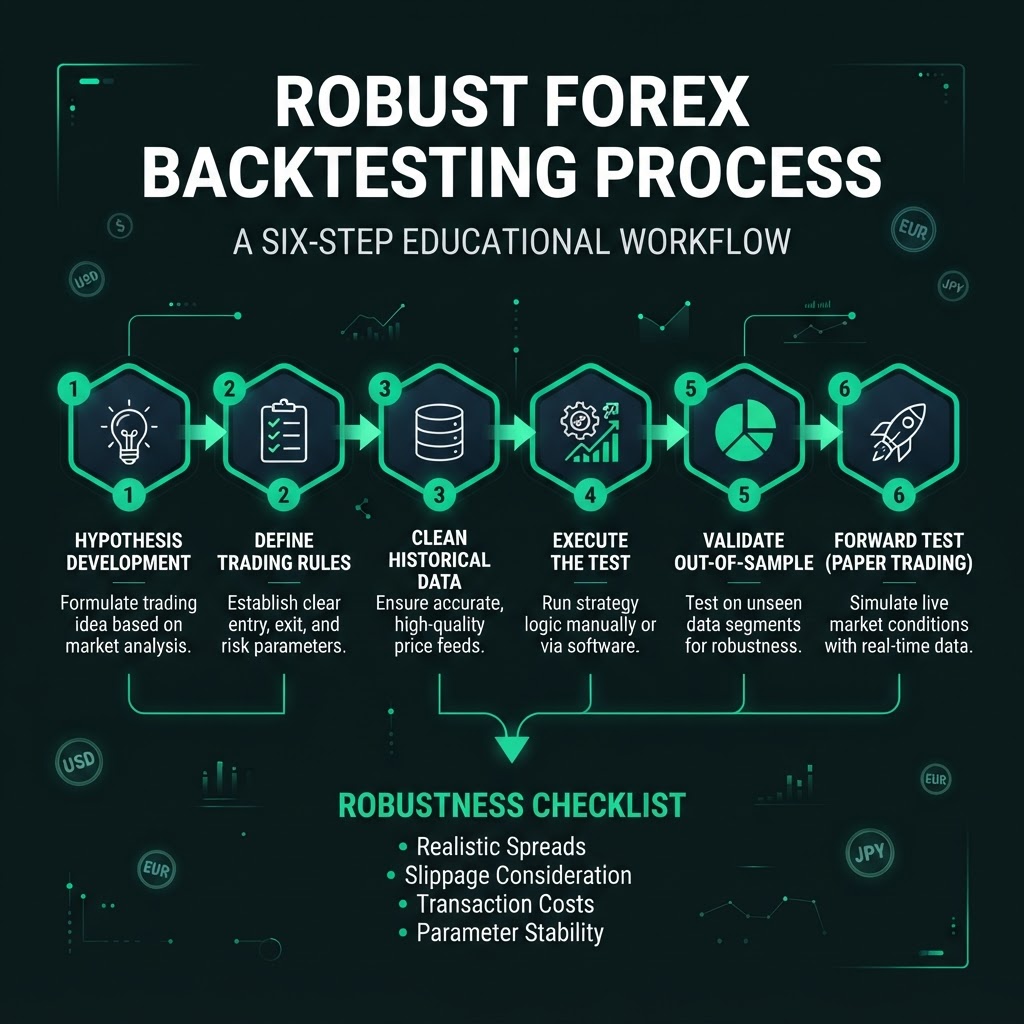
- 1State the market hypothesis.
- 2Write complete rules before testing.
- 3Obtain clean data and model costs.
- 4Run the in-sample test.
- 5Validate on untouched data.
- 6Stress-test assumptions and trade order.
- 7Forward-test in real time with no or minimal risk.
- 8Compare live behavior with the expected range.
Sample Size
A small number of trades creates wide uncertainty. There is no universal minimum, but conclusions based on 20 trades are fragile. Seek enough examples across different conditions, and report confidence intervals rather than treating the observed win rate as permanent.
Final Takeaway
A good backtest is an attempt to disprove a strategy, not advertise it. Keep rules objective, protect unseen data, model execution honestly, and demand stable results before risking capital.