The US Dollar Index (DXY): A Practical Guide for Forex Traders
The US Dollar Index (DXY): A Practical Guide for Forex Traders
What DXY Measures
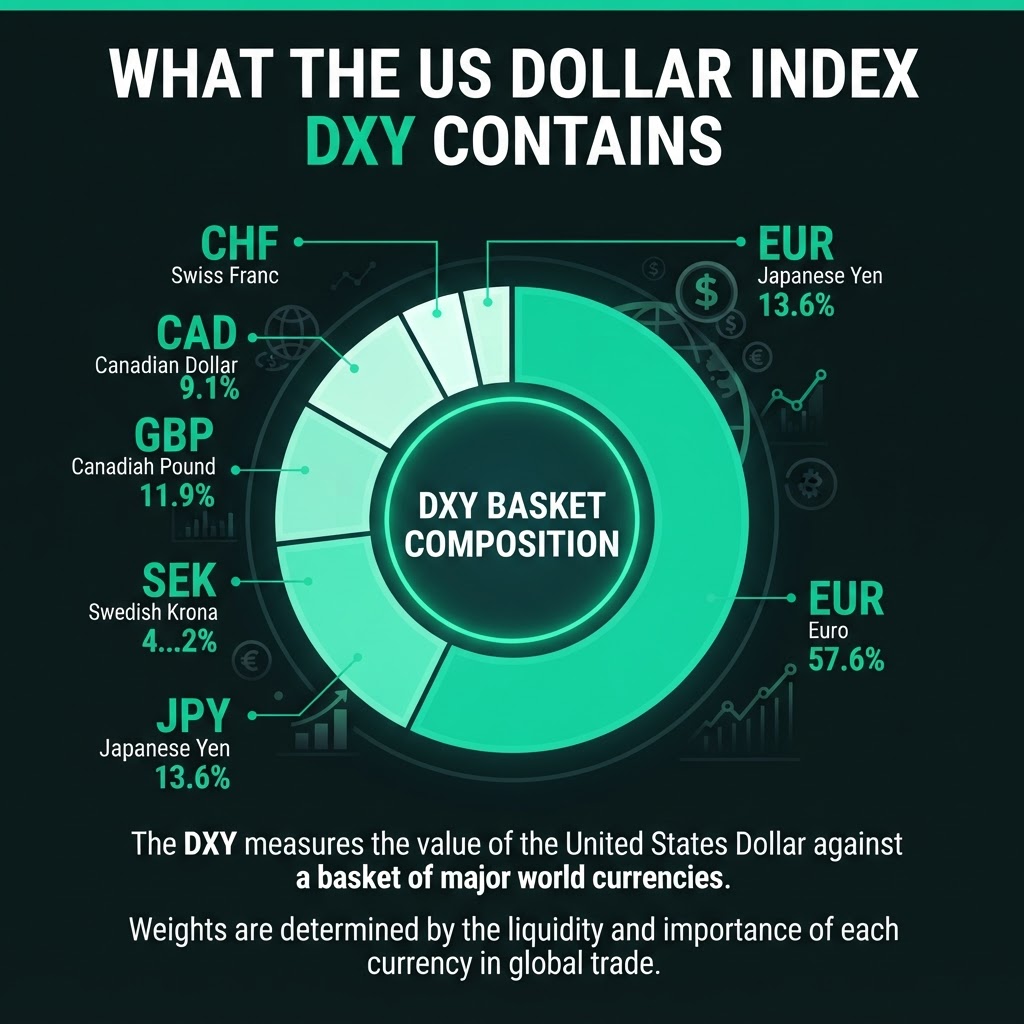
The U.S. Dollar Index tracks the dollar against a fixed basket of six currencies. It rises when the dollar strengthens against the basket and falls when the dollar weakens. Forex traders use it as a broad reference for dollar direction, momentum, and important technical levels.
The euro carries the largest weight at approximately 57.6%, followed by the Japanese yen, British pound, Canadian dollar, Swedish krona, and Swiss franc. Because the euro dominates the calculation, DXY is not an equal-weight measure of the dollar against the entire world.
DXY and EUR/USD
EUR/USD often moves inversely to DXY. When the euro strengthens against the dollar, EUR/USD rises while the heavily euro-weighted index tends to fall. The relationship is strong but not mathematically perfect because five other currencies also contribute.

Avoid counting DXY and EUR/USD as two independent confirmations. Much of the information overlaps. Instead, use a divergence between them as a reason to investigate what another basket currency is doing.
What Drives the Dollar Index?
The index responds to relative monetary policy and economic expectations. A stronger U.S. rate outlook can lift Treasury yields and make dollar assets more attractive. Weak growth or expected rate cuts can pressure the currency, although risk aversion may still support the dollar through safe-haven demand.
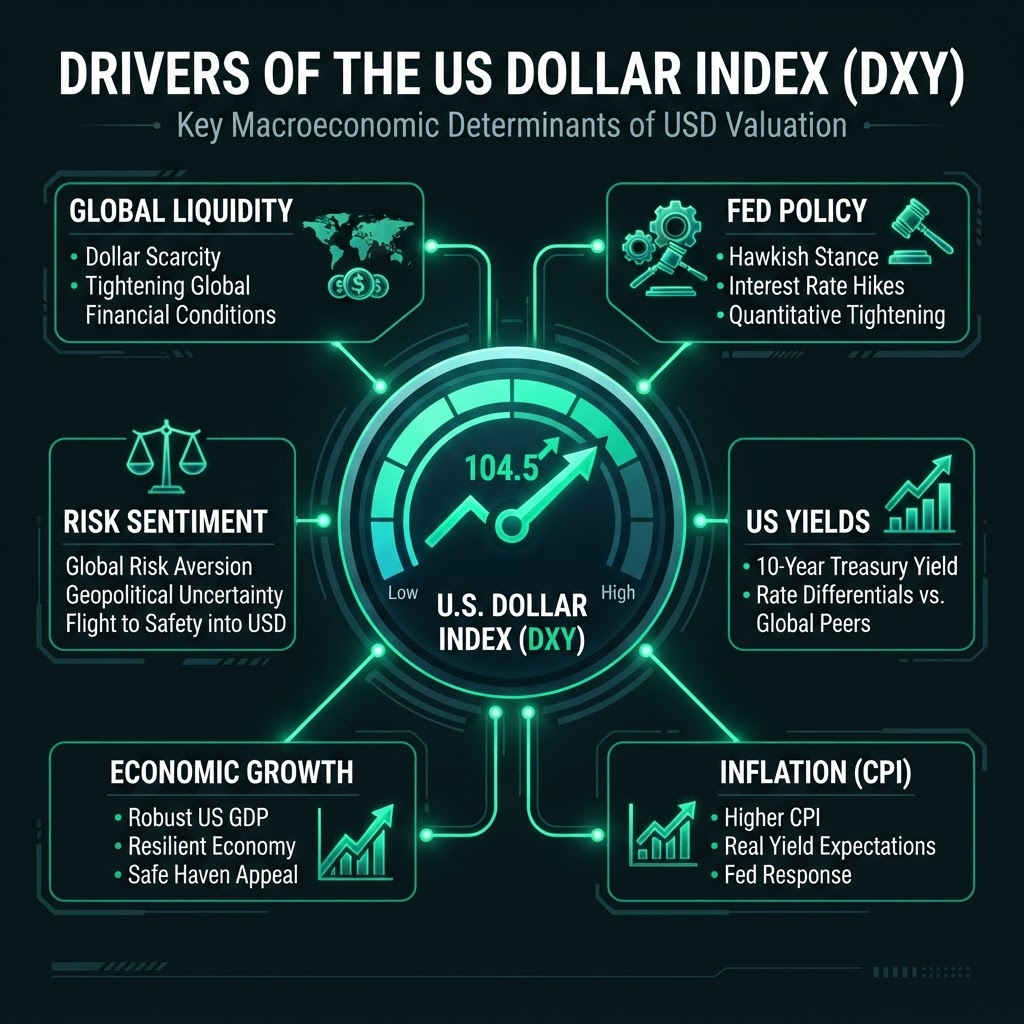
Important drivers include:
- Federal Reserve policy and forward guidance.
- U.S. inflation, employment, and growth data.
- Relative bond yields.
- Global risk sentiment and liquidity.
- Economic conditions in Europe and Japan.
- Demand for safe and liquid assets.
Using DXY as Confirmation
Start by analyzing the currency pair itself. Then check whether DXY supports the idea. A DXY breakout from resistance may strengthen a bearish EUR/USD thesis. A DXY failure at resistance may support dollar-weakness setups.
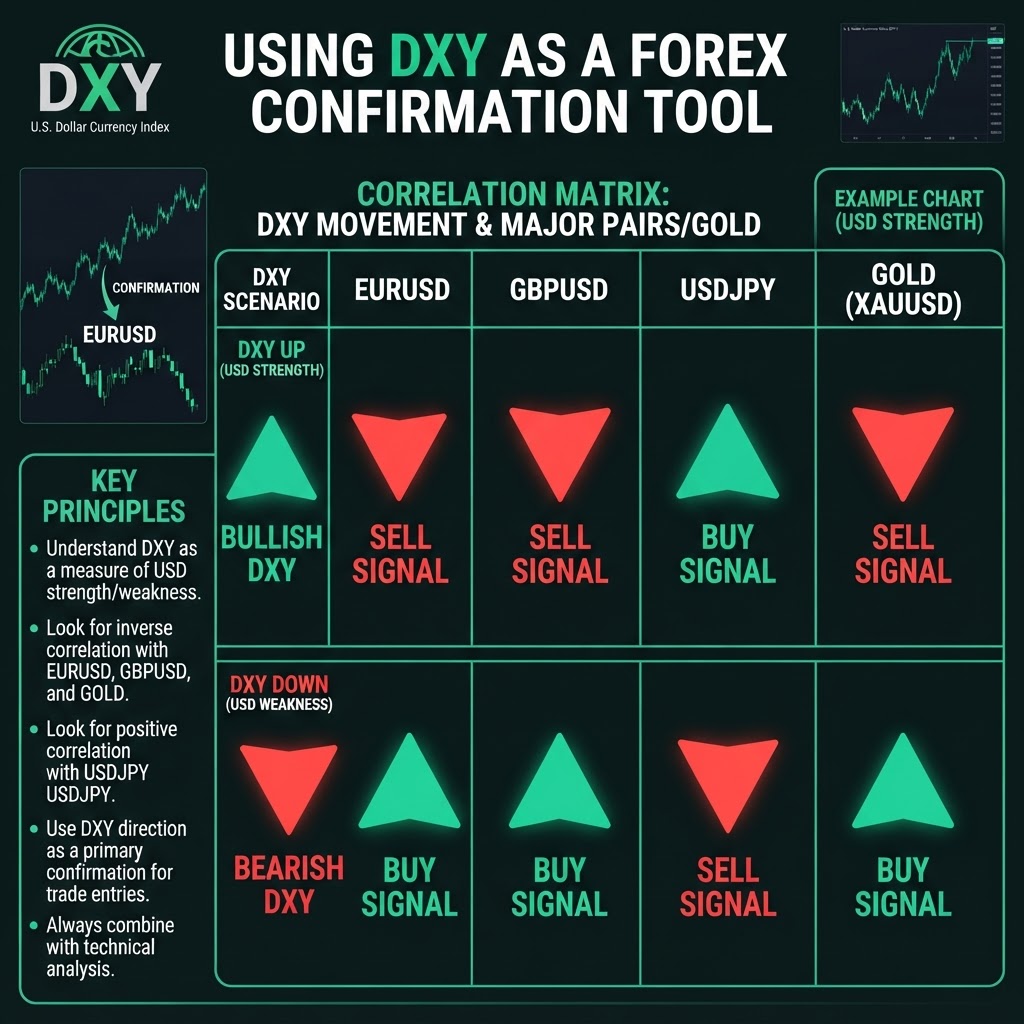
For USD/JPY, the relationship can be more complicated because both the dollar and yen may benefit from risk aversion. Commodity currencies respond to additional factors such as oil, metals, and Chinese growth. This is why DXY should confirm context rather than replace pair-specific analysis.
Technical Application
Mark weekly support and resistance, major trend structure, and zones around important macro events. Compare DXY momentum with the pair being traded. If both support the same dollar view, confidence may improve; if they conflict, reduce size or wait.
Limitations
DXY excludes currencies such as the Chinese yuan, Mexican peso, Australian dollar, and New Zealand dollar. Its fixed weights also reflect an older trade structure. It is therefore a focused legacy benchmark, not a complete map of global dollar strength.
Final Takeaway
DXY is most useful as a broad dollar lens. Understand its euro-heavy construction, identify the macro forces moving it, and use it as secondary confirmation while keeping the traded pair's own fundamentals and structure at the center of the decision.