Risk-to-Reward Ratio: The Math Behind Profitable Trading
Risk-to-Reward Ratio: The Math Behind Profitable Trading
Introduction: Why Winners Are Not Enough
Many traders believe that the key to profitability is a high win rate — being right more often than you are wrong. This is one of the most dangerous misconceptions in trading. The truth is that you can be right 70% of the time and still lose money if your losses are larger than your winners. Conversely, you can be right only 40% of the time and be highly profitable if your winners are much larger than your losers.
The concept that makes this possible is the risk-to-reward ratio (R:R). It is the single most important mathematical relationship in trading, and understanding it is the difference between a gambler and a professional.
What Is Risk-to-Reward Ratio?
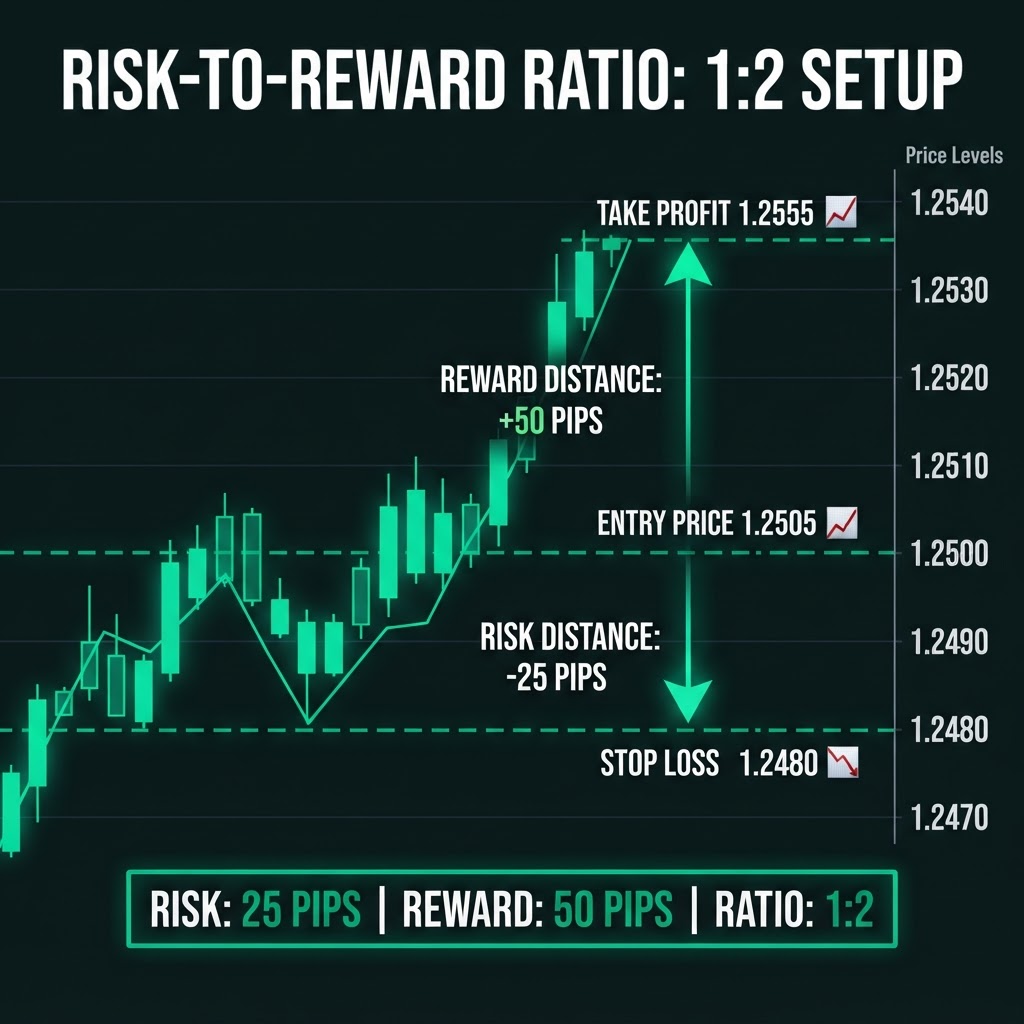
The risk-to-reward ratio compares the amount you risk losing on a trade to the amount you stand to gain. It is expressed as a ratio, such as 1:2, which means you risk 1 unit to potentially gain 2 units.
How to Calculate R:R
- 1Risk: The distance from your entry price to your stop-loss price. This is the amount you lose if your stop is hit.
- 2Reward: The distance from your entry price to your take-profit price. This is the amount you gain if your target is hit.
- 3R:R Ratio = Risk : Reward
For example, if you enter a trade at 1.1000, place your stop loss at 1.0970 (30 pips risk), and your take profit at 1.1060 (60 pips reward), your R:R is 1:2.
What Makes a Good R:R?
A favorable R:R means your potential reward is larger than your potential risk. Here is what different ratios look like:
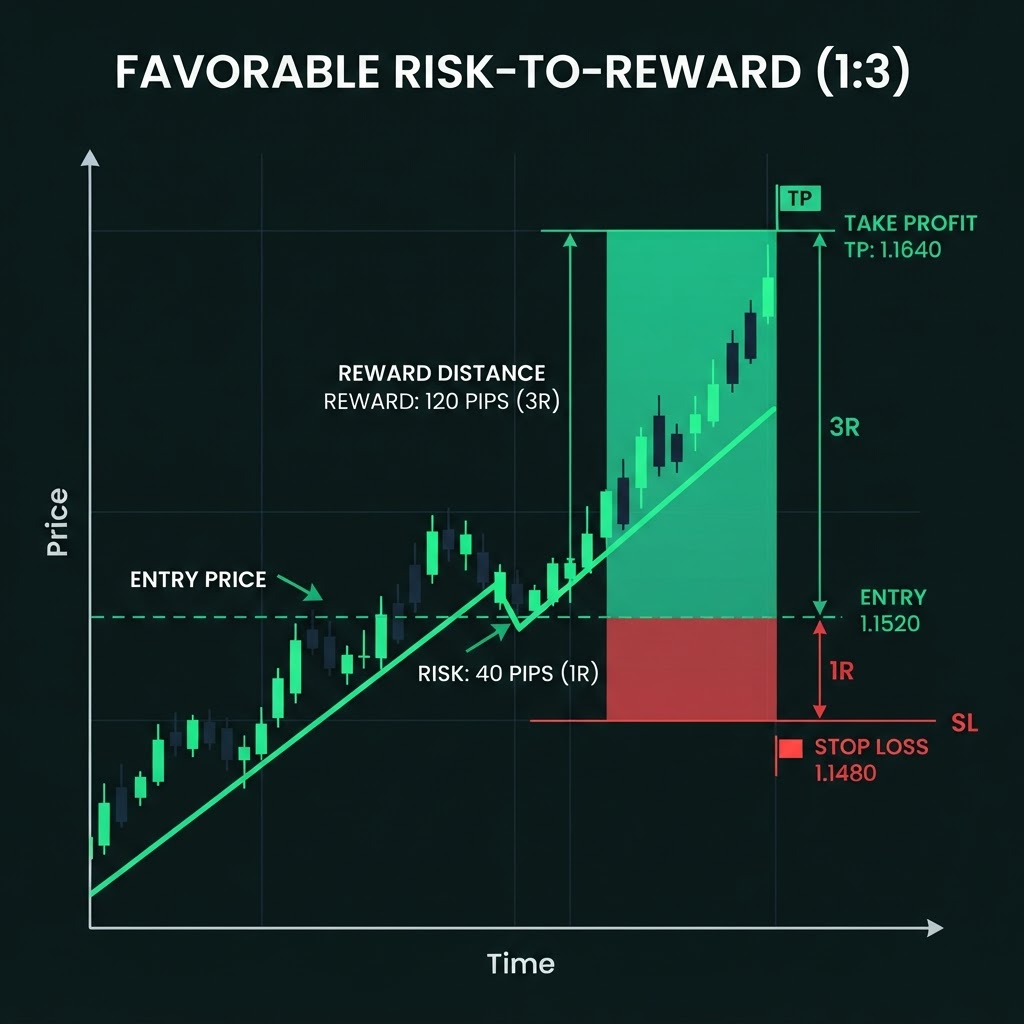
Favorable R:R (1:2 or better)
- You risk $100 to make $200 (1:2)
- You risk $100 to make $300 (1:3)
- Even if you lose more trades than you win, the large winners can offset the small losers.
Unfavorable R:R (1:1 or worse)
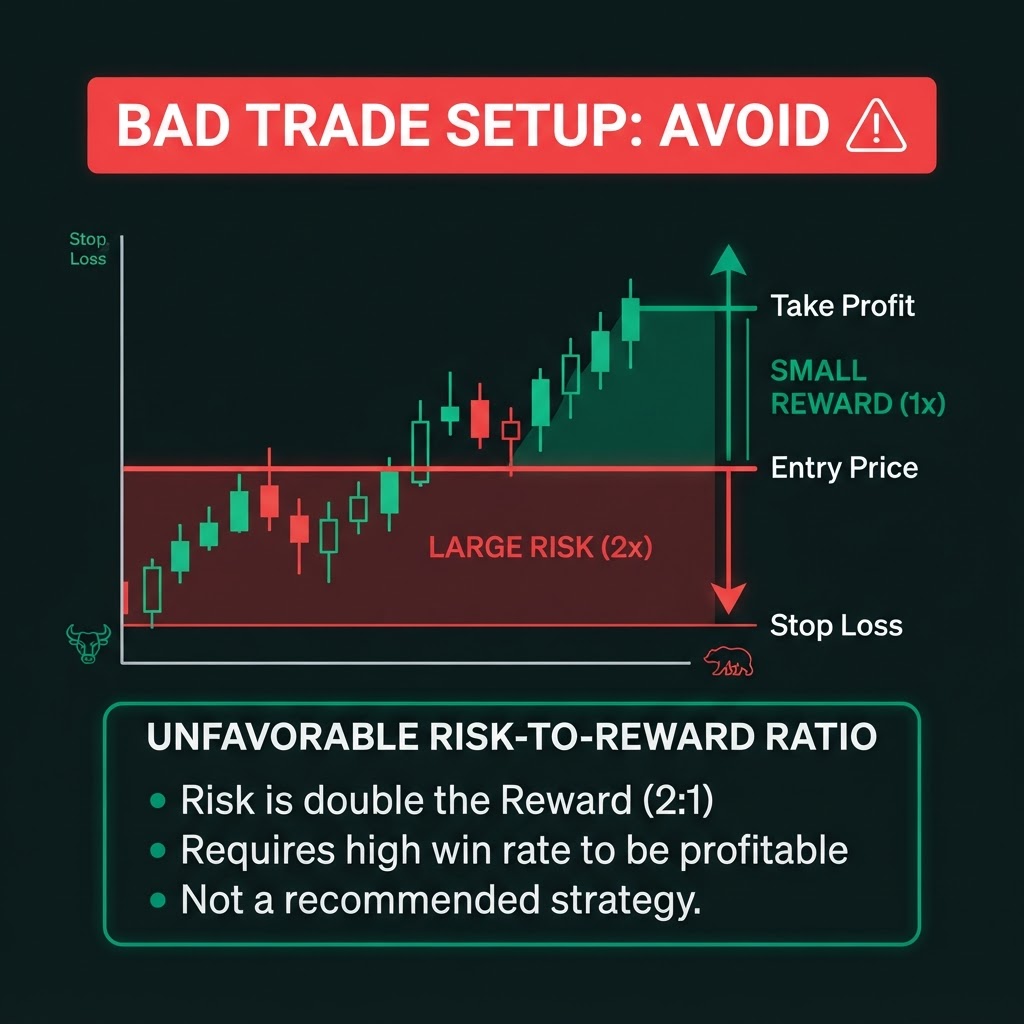
- You risk $200 to make $100 (2:1 — reward is smaller than risk)
- You need a very high win rate to be profitable.
- One large loss can wipe out multiple small wins.
The Math: Why R:R Is More Important Than Win Rate
The relationship between win rate and R:R determines your overall profitability. This is called expectancy.
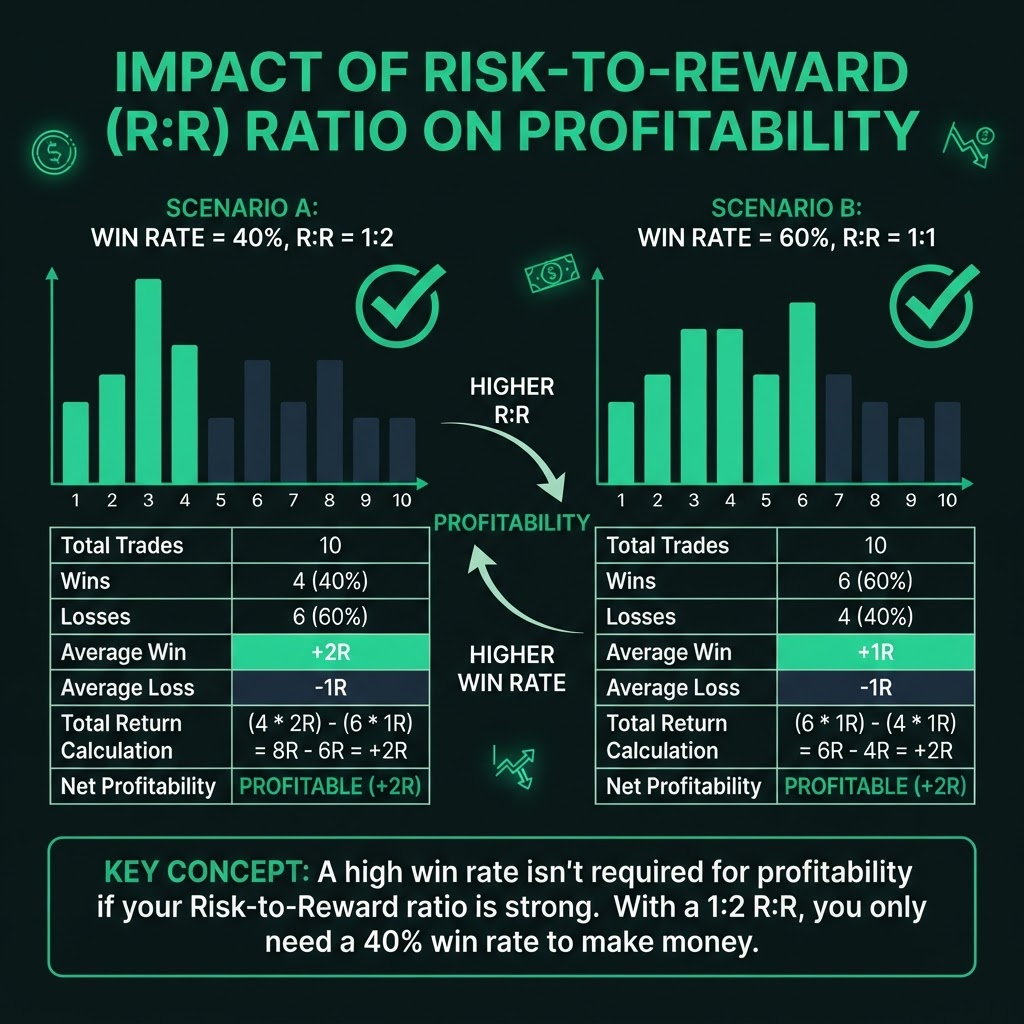
Expectancy Formula
Expectancy = (Win Rate × Average Win) - (Loss Rate × Average Loss)
If your win rate is 40%, your average win is $300, and your average loss is $100:
Expectancy = (0.40 × $300) - (0.60 × $100) = $120 - $60 = $60 per trade
This means that even though you lose 60% of your trades, you still make $60 on average per trade. This is the power of a favorable R:R.
The Break-Even Win Rate
For any R:R, there is a break-even win rate — the win rate at which you neither make nor lose money:
| R:R Ratio | Break-Even Win Rate |
|---|---|
| 1:1 | 50% |
| 1:2 | 33.3% |
| 1:3 | 25% |
| 1:4 | 20% |
With a 1:2 R:R, you only need to win 34% of your trades to break even. Anything above that is profit. With a 1:3 R:R, you only need to win 25% of your trades. This gives you a tremendous margin for error.
Comparing Two Traders
Trader A: 70% win rate, 1:0.5 R:R (risks $200 to make $100)
- Expectancy = (0.70 × $100) - (0.30 × $200) = $70 - $60 = $10 per trade
Trader B: 40% win rate, 1:3 R:R (risks $100 to make $300)
- Expectancy = (0.40 × $300) - (0.60 × $100) = $120 - $60 = $60 per trade
Trader B makes 6 times more per trade than Trader A, despite winning only 40% of the time. This is why professionals focus on R:R, not win rate.
How to Achieve a Favorable R:R
1. Let Your Winners Run
The most common reason traders have poor R:R is that they cut their winners short. They take a 20-pip profit but let losses run to 50 pips. To achieve a good R:R, you need the discipline to let winning trades reach their full target.
Technique: Use trailing stops to lock in profits while giving the trade room to continue. Move your stop loss to break even once the trade is in profit by 1R, then trail it behind swing points.
2. Cut Your Losers Early
The second most common mistake is holding losing trades too long, hoping they will turn around. A small loss is a good loss. Define your stop loss before you enter and honor it without exception.
Technique: Place your stop loss order at the same time you enter the trade. Never move it further away to give the trade "more room."
3. Choose Trade Setups with Natural R:R
Some trade setups inherently offer better R:R than others. For example:
- Entering at a supply/demand zone with a tight stop just beyond the zone can offer 1:5 or better R:R.
- Entering at a trend line bounce with a stop just beyond the line can offer 1:3 or better.
- Entering a breakout in the middle of a range often offers only 1:1 R:R because the nearest opposite boundary is close.
Technique: Before entering any trade, calculate the R:R. If it is less than 1:2, skip the trade. There will always be another opportunity.
4. Use Multiple Targets
Instead of taking all your profit at one level, scale out at multiple targets. For example:
- Close 50% at 1R (locks in a no-loss trade if you move stop to break even)
- Close 25% at 2R
- Close 25% at 3R or trail the rest
This approach improves your overall R:R while reducing the psychological pressure of holding for a single large target.
Common Mistakes
- 1Moving stop losses: The moment you move your stop loss further away to avoid a loss, your R:R deteriorates. Your planned 1:2 trade becomes a 1:0.5 trade.
- 1Taking profits too early: Closing a winning trade at 0.5R because you are afraid it will reverse destroys your R:R. Trust your analysis and let the trade breathe.
- 1Not calculating R:R before entry: If you do not know your R:R before entering, you are gambling. Always calculate it.
- 1Revenge trading: After a loss, entering a trade with a poor R:R just to make back the loss quickly. This compounds the problem.
- 1Ignoring the quality of the setup: A 1:5 R:R on a low-probability setup is worse than a 1:2 R:R on a high-probability setup. R:R must be considered alongside win rate.
Conclusion
The risk-to-reward ratio is the mathematical foundation of profitable trading. It is the reason a trader with a 40% win rate can outperform one with a 70% win rate. By consistently risking less than you stand to gain, you give yourself a statistical edge that compounds over time. The key is discipline: define your risk before entry, honor your stop loss, let your winners run, and never enter a trade with an R:R less than 1:2. Master this one concept, and you will have taken the most important step toward becoming a consistently profitable trader.