Margin and Leverage: The Complete Guide for Forex Traders
Margin and Leverage: The Complete Guide for Forex Traders
Introduction: The Double-Edged Sword
Margin and leverage are two of the most powerful — and most dangerous — concepts in forex trading. They allow traders to control large positions with relatively small amounts of capital, amplifying both profits and losses. Understanding how they work is not optional; it is the difference between surviving and thriving as a trader, or losing your entire account in a single trade.
In this article, we will break down the mechanics of margin, explore how leverage ratios work, explain margin calls, and discuss how to use leverage safely.
What Is Margin?
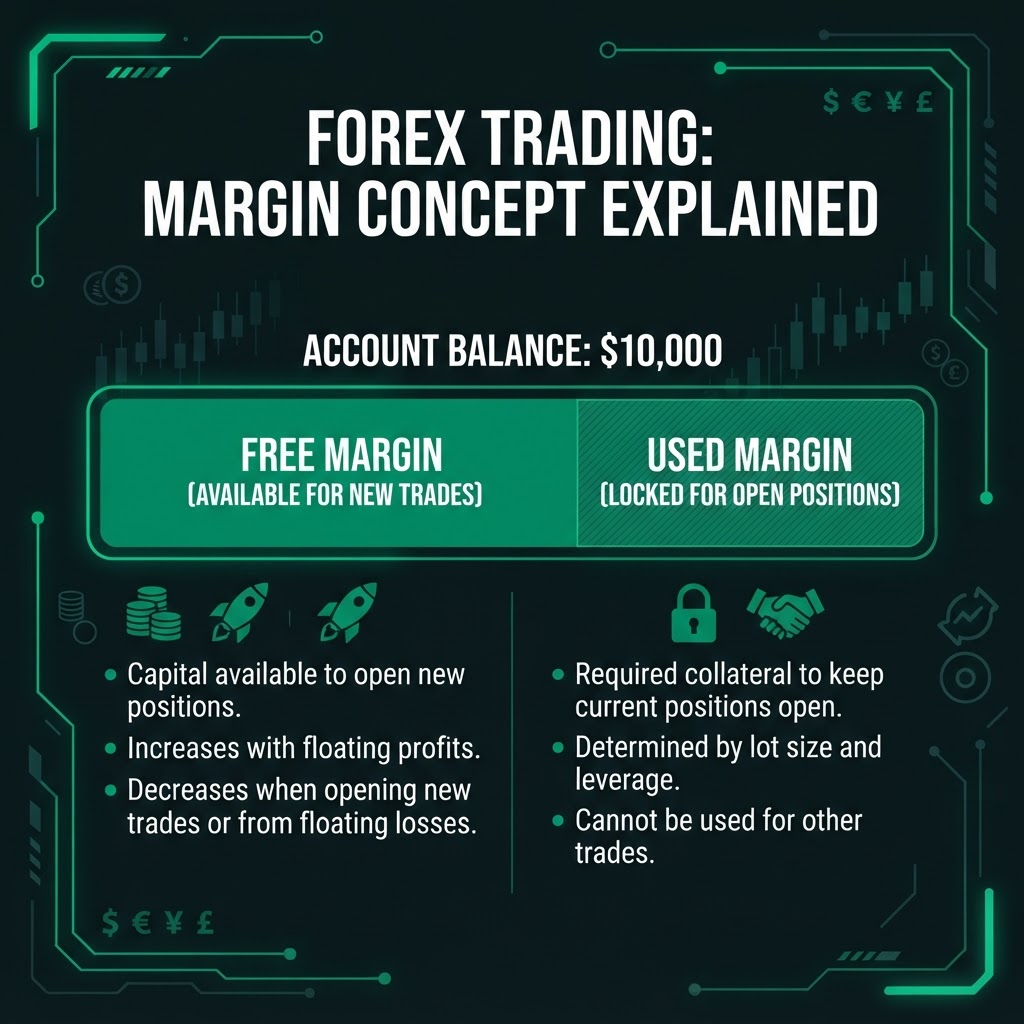
Margin is the amount of money your broker sets aside (locks up) as collateral when you open a position. It is not a cost or a fee — it is a deposit that ensures you have enough skin in the game to cover potential losses.
Used Margin vs. Free Margin
- Used Margin: The total amount of capital currently locked as collateral for all your open positions. This money cannot be used to open new trades.
- Free Margin: The remaining capital in your account that is available for opening new positions or absorbing floating losses.
- Equity: Your account balance plus or minus the floating P&L of your open positions.
For example, if you have a $10,000 account and open a position that requires $1,000 in margin, your used margin is $1,000 and your free margin is $9,000.
What Is Leverage?
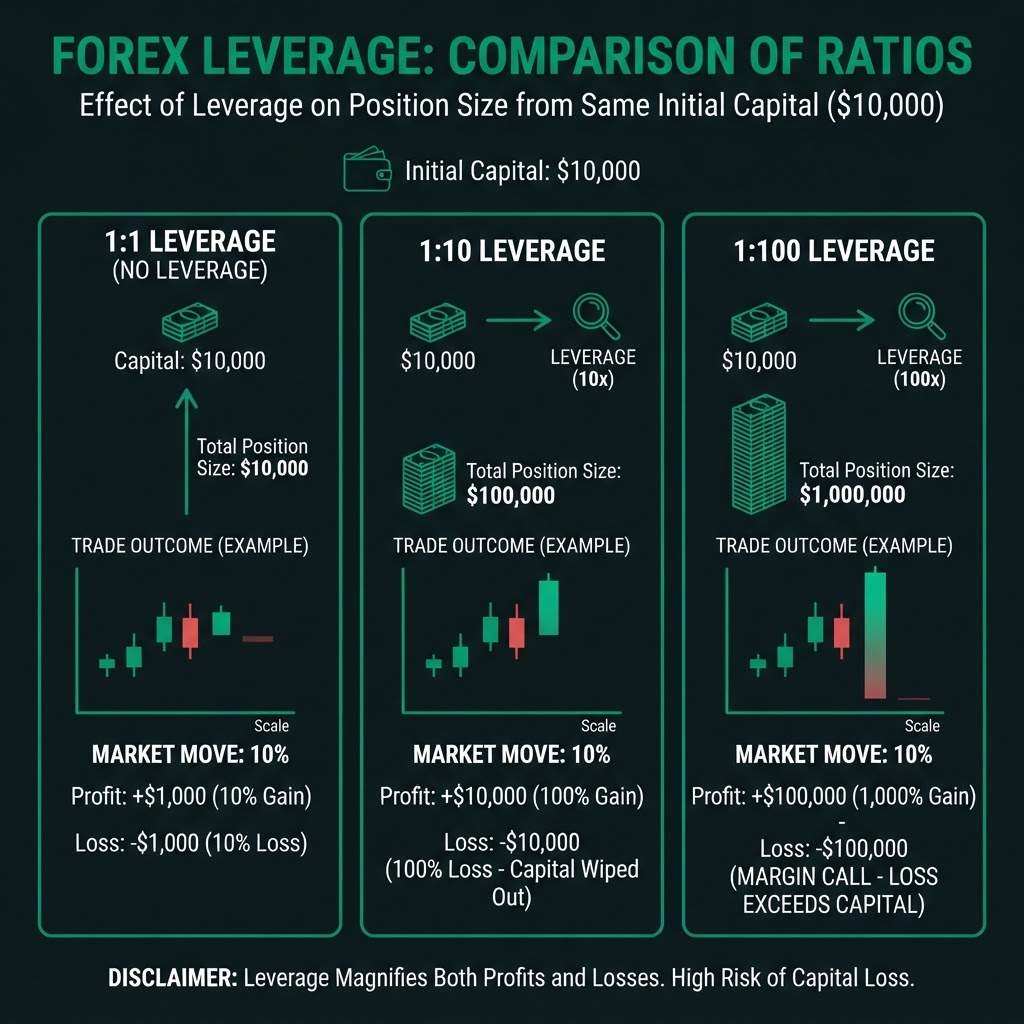
Leverage is the ratio between the total position size and the required margin. It tells you how much your capital is being multiplied. A leverage of 1:100 means that for every $1 of margin, you can control $100 of position size.
How Leverage Ratios Work
| Leverage | Margin Required | Position Size |
|---|---|---|
| 1:1 | $100,000 | $100,000 |
| 1:10 | $10,000 | $100,000 |
| 1:50 | $2,000 | $100,000 |
| 1:100 | $1,000 | $100,000 |
| 1:500 | $200 | $100,000 |
With 1:500 leverage, you can control a $100,000 position with just $200. This sounds incredible — but it is also incredibly dangerous. A small price movement against you can wipe out your entire margin.
The Math of Leverage
In forex, a standard lot is 100,000 units of the base currency. A 1-pip move on a standard lot of EUR/USD is worth approximately $10.
If you have $1,000 in your account and use 1:100 leverage to open a standard lot ($100,000 position), a 100-pip move against you would cost you $1,000 — your entire account. This is why leverage must be used with extreme caution.
Margin Calls and Stop Outs
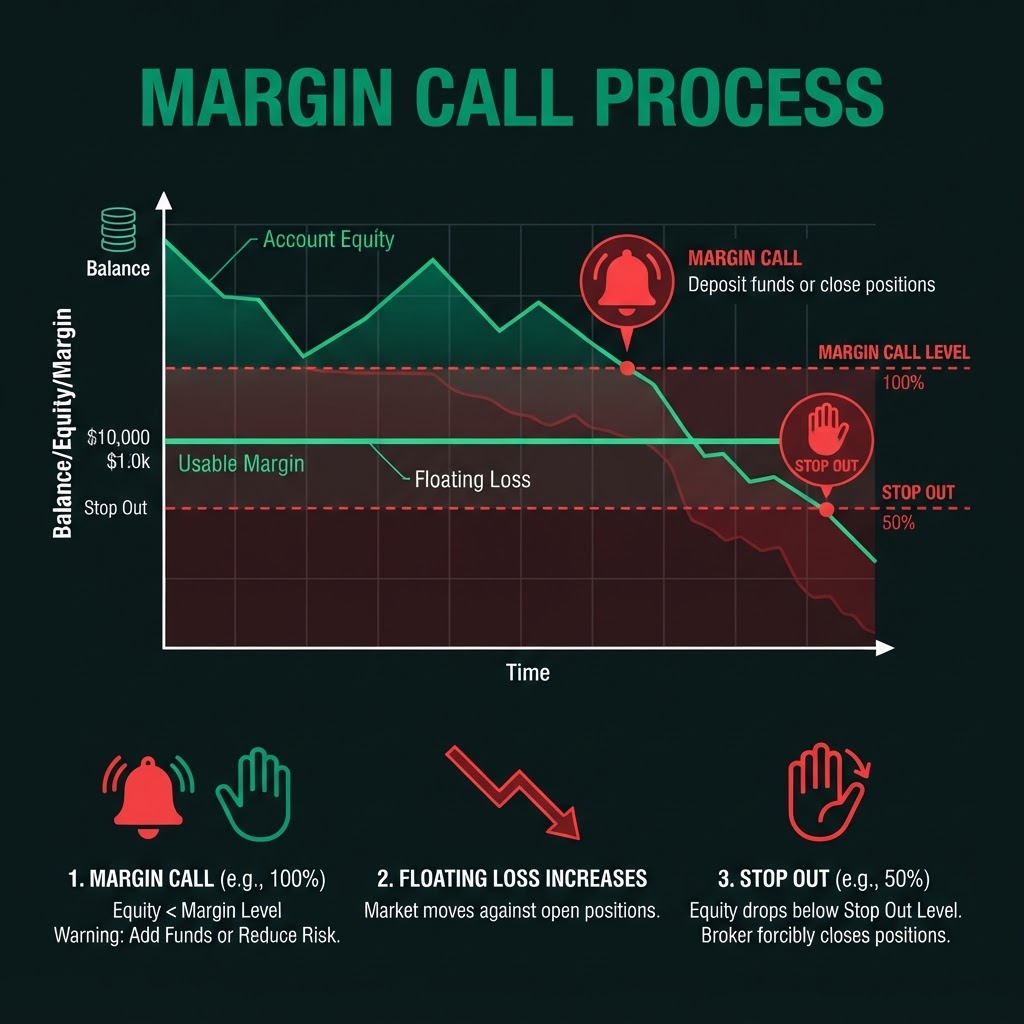
A margin call occurs when your floating losses eat into your margin to the point where your broker warns you that you need to deposit more funds or close positions. If you do not act, the broker will eventually close your positions automatically — this is called a stop out.
How Margin Levels Are Calculated
- Margin Level = (Equity / Used Margin) × 100
When your margin level drops to a certain percentage (typically 100% or 50%, depending on the broker), a margin call is triggered. If it drops further to the stop-out level (typically 20-50%), the broker automatically closes your positions.
Example
You have a $5,000 account and open a position requiring $1,000 in margin. Your margin level starts at 500% ($5,000 / $1,000 × 100). If your floating loss reaches $4,000, your equity drops to $1,000, and your margin level drops to 100% — margin call territory. If losses continue and equity drops to $500, your margin level is 50% — and the broker may stop you out.
Safe vs. Dangerous Leverage Usage
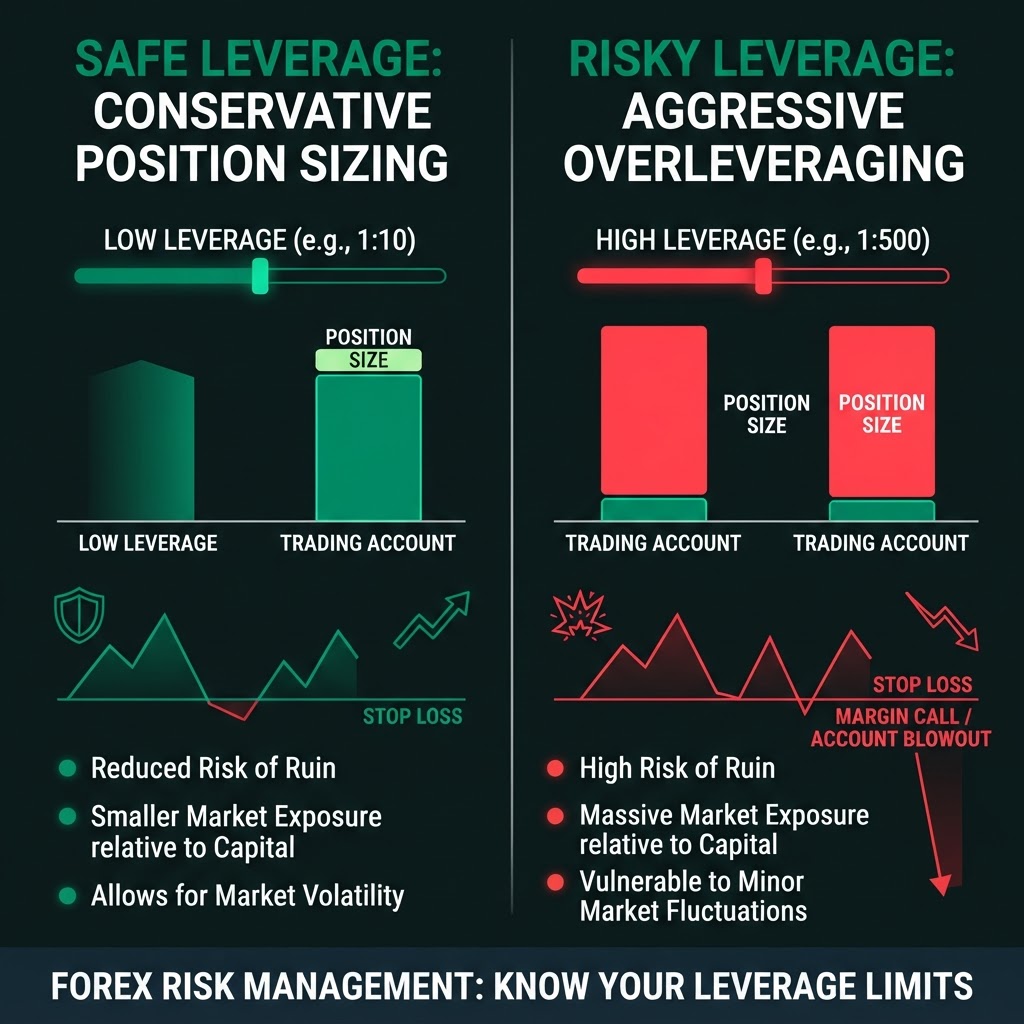
The key to using leverage safely is understanding that high leverage does not mean you should take larger positions. It means you can take the same position with less capital — leaving more free margin as a buffer.
The Safe Approach
A conservative trader with a $10,000 account might:
- Risk no more than 1-2% of their account per trade ($100-$200)
- Use a stop loss of 50 pips
- Calculate position size so that 50 pips = $100 risk
- This requires a position of 0.2 lots ($20,000), which with 1:100 leverage needs only $200 in margin
- Even though the broker offers 1:500 leverage, the trader uses it as if it were 1:5
The Dangerous Approach
An overleveraged trader with the same $10,000 account might:
- Open 5 standard lots ($500,000) with 1:100 leverage, using $5,000 in margin
- A 100-pip move against them = $5,000 loss = 50% of the account gone in one trade
- A 200-pip move = account blown out
Practical Rules for Managing Margin and Leverage
- 1Never use maximum leverage: Just because your broker offers 1:500 does not mean you should use it. Treat leverage as a tool for capital efficiency, not for taking bigger risks.
- 2Risk a small percentage per trade: Professional traders typically risk 0.5-2% of their account per trade. This ensures that even a string of losses does not wipe out the account.
- 3Always use a stop loss: Without a stop loss, a leveraged position can generate unlimited losses. A stop loss defines your maximum risk before you enter the trade.
- 4Monitor your free margin: Before opening a new position, check that you have enough free margin to absorb normal market fluctuations without triggering a margin call.
- 5Avoid holding positions over the weekend with high leverage: Weekend gaps can skip your stop loss and cause losses far greater than expected.
Conclusion
Margin and leverage are powerful tools that make forex trading accessible to traders with modest capital. But they are also the reason most retail traders lose money. The difference between a professional and a gambler is not the size of their leverage — it is the discipline with which they use it. Use leverage to make your capital usage more efficient, not to make your positions bigger. Risk small, use stop losses, and treat your free margin as your most precious resource.