Understanding Currency Pairs: Majors, Minors, and Exotics
Understanding Currency Pairs: A Comprehensive Guide to Forex Markets
Introduction to Currency Pairs
The foreign exchange market, commonly known as Forex or FX, is the largest and most liquid financial market in the world. Unlike the stock market, where you purchase shares of a company, the forex market involves the simultaneous buying of one currency and the selling of another. Because currencies are always valued in relation to other currencies, they are traded in "pairs."
When you participate in the forex market, you are essentially speculating on the strength of one nation's economy versus another. If you believe the U.S. economy will outperform the European economy, you might buy the U.S. Dollar while selling the Euro. Understanding how these pairs are categorized—majors, minors, and exotics—is the foundational knowledge required for any aspiring trader. Each category carries distinct characteristics regarding volatility, liquidity, and trading costs, all of which play a critical role in your overall trading strategy and risk management.
Base and Quote Currencies Explained
Every currency pair is composed of two components: the base currency and the quote currency. The base currency is the first currency listed in the pair, while the quote currency (also known as the counter currency) is the second one.
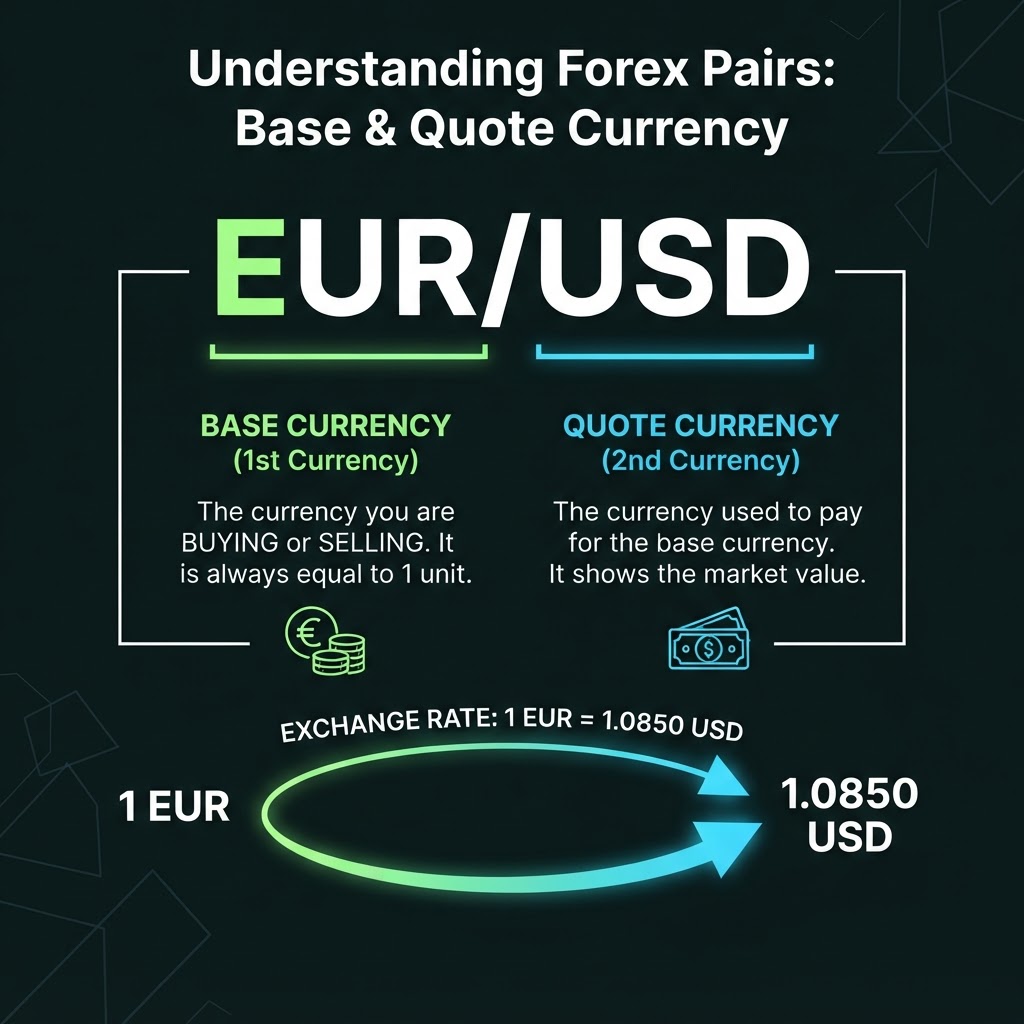
In the pair EUR/USD, the Euro (EUR) is the base currency, and the U.S. Dollar (USD) is the quote currency. The price of this pair represents how much of the quote currency is needed to purchase one unit of the base currency. For example, if EUR/USD is trading at 1.0850, it means that one Euro can be exchanged for 1.0850 U.S. Dollars.
- Buying the Pair: When you "go long" or buy a currency pair, you are buying the base currency and selling the quote currency. You anticipate that the base currency will appreciate (gain value) relative to the quote currency.
- Selling the Pair: When you "go short" or sell a currency pair, you are selling the base currency and buying the quote currency. You anticipate that the base currency will depreciate (lose value) relative to the quote currency.
Grasping this concept is vital because it dictates the direction of your trade. If you expect global risk sentiment to improve, you might buy AUD/USD; if you expect global instability, you might look to sell it, effectively moving your capital into the U.S. Dollar, which is often viewed as a "safe-haven" asset.
The Major Currency Pairs
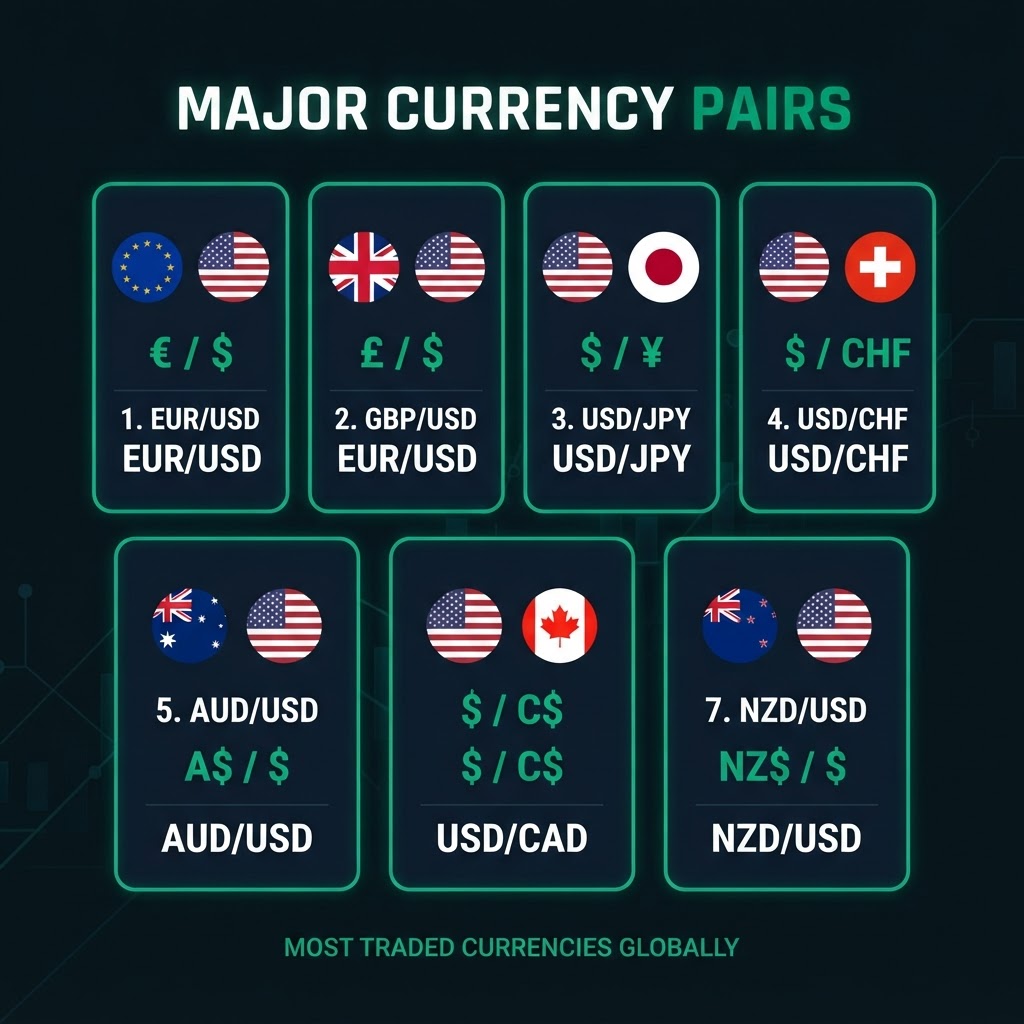
Major currency pairs, often referred to as the "Majors," are the most actively traded pairs in the global forex market. These pairs always involve the U.S. Dollar (USD) on one side and another major global currency on the other. Because the U.S. Dollar is the world’s primary reserve currency, these pairs command the highest trading volume and exhibit the most liquidity.
The primary major pairs include:
- EUR/USD (The "Fiber"): The most liquid and widely traded pair in the world. It reflects the economic relationship between the Eurozone and the United States.
- GBP/USD (The "Cable"): Known for its high volatility and rapid price movements, this pair represents the British Pound and the U.S. Dollar.
- USD/JPY (The "Gopher"): Highly sensitive to interest rate differentials between the Federal Reserve and the Bank of Japan. It is often used as a barometer for global risk appetite.
- USD/CHF (The "Swissie"): Linked to the Swiss Franc, which is traditionally viewed as a defensive, safe-haven currency.
- AUD/USD (The "Aussie"): Heavily influenced by commodity prices, particularly gold and iron ore, as Australia is a major exporter of raw materials.
- USD/CAD (The "Loonie"): Strongly correlated with oil prices, as Canada is a top global oil producer.
- NZD/USD (The "Kiwi"): Similar to the Aussie, it is sensitive to commodity prices and global economic growth.
Because they are traded by banks, hedge funds, and governments globally, majors typically have the tightest spreads and are less prone to "slippage," making them the most popular choice for retail traders.
Minor (Cross) Currency Pairs
Minor pairs, also known as "Cross" pairs or simply "Crosses," are currency pairs that do not include the U.S. Dollar. Historically, traders would first have to convert their currency into USD to trade another pair. Crosses allow traders to bypass the USD, providing more direct exposure to other economies.
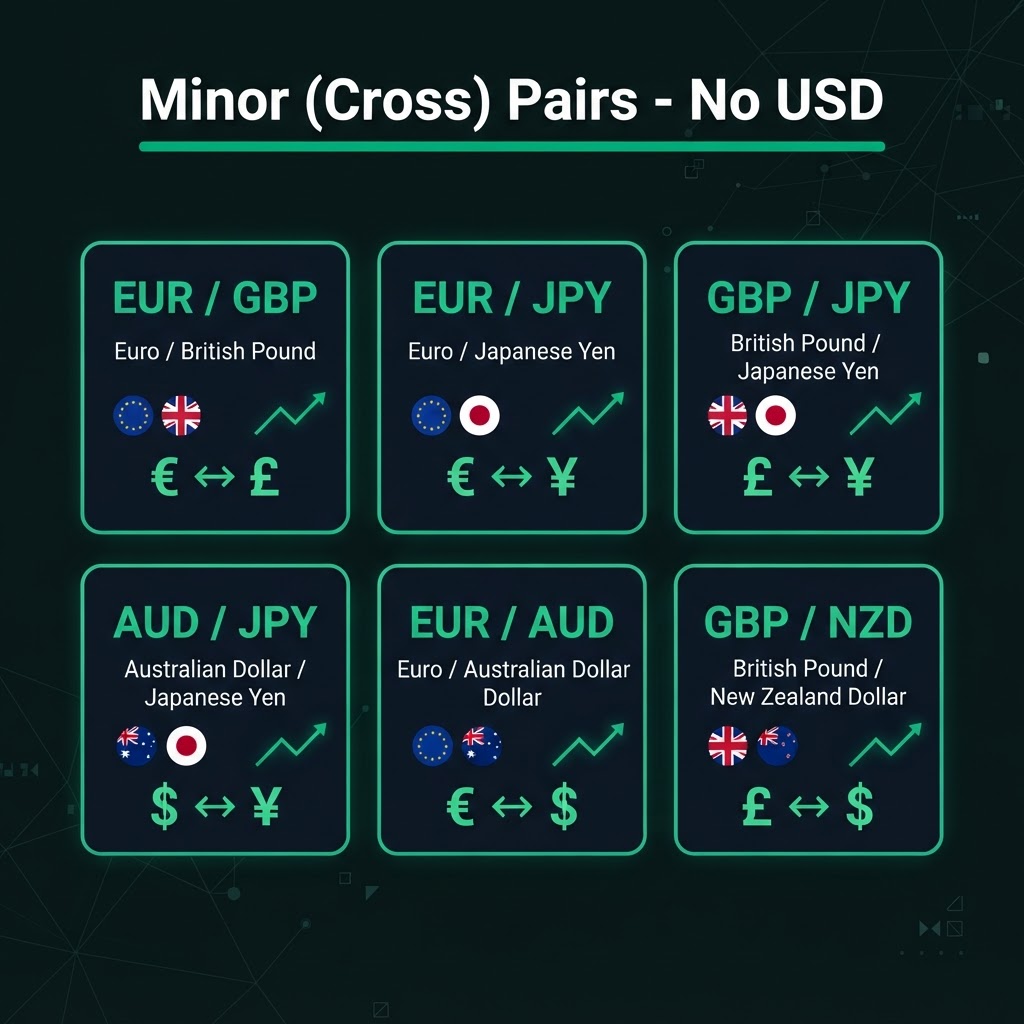
Commonly traded crosses include:
- EUR-based crosses: EUR/GBP, EUR/JPY, EUR/CHF.
- GBP-based crosses: GBP/JPY, GBP/AUD, GBP/CAD.
- JPY-based crosses: AUD/JPY, CAD/JPY, CHF/JPY.
Minor pairs often experience slightly lower liquidity than majors, which means spreads may be slightly wider. However, they are excellent for traders who have a specific view on a non-USD currency. For instance, if you are bullish on the Japanese Yen but bearish on the British Pound, trading GBP/JPY allows you to capitalize on that specific divergence without involving the U.S. Dollar in your analysis.
Exotic Currency Pairs
Exotic pairs consist of one major currency paired with the currency of a developing or emerging economy. Examples include the Mexican Peso (MXN), South African Rand (ZAR), Turkish Lira (TRY), or Brazilian Real (BRL).
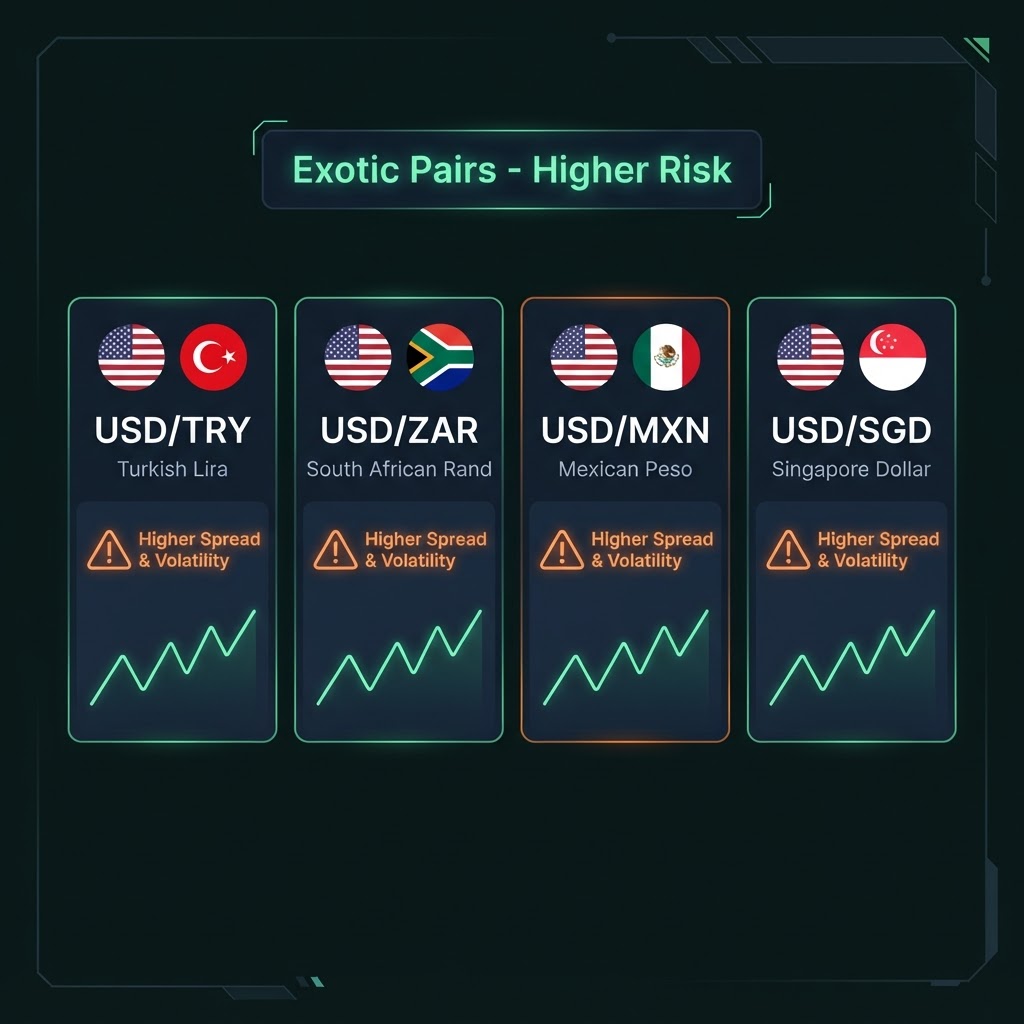
Exotic pairs are characterized by:
- High Volatility: Prices can fluctuate wildly based on political instability, central bank interventions, or sudden shifts in emerging market sentiment.
- Lower Liquidity: Because fewer participants trade these currencies, there is less volume. This often leads to "wider spreads," meaning the cost to enter and exit a trade is significantly higher.
- High Transaction Costs: Due to the lower liquidity, brokers often charge higher commissions or widen spreads, making short-term "scalping" strategies very difficult.
Trading exotics requires advanced knowledge of geopolitical factors and a higher risk tolerance. They are generally not recommended for beginners.
Liquidity and Spreads Across Pair Types
Liquidity refers to how easily a currency can be bought or sold without causing a significant shift in its price. Majors, being the most traded, have the highest liquidity. Because so many people are buying and selling EUR/USD at any given second, you can enter or exit a trade almost instantly at the quoted price.
The spread—the difference between the bid (sell) price and the ask (buy) price—is the primary cost of trading. In high-liquidity environments like the majors, brokers offer tight spreads because there is constant volume.
As you move from majors to minors and then to exotics, liquidity decreases. Lower liquidity leads to wider spreads. When you trade an exotic pair, your broker has to assume more risk because they may not find an immediate counterparty for your trade; they pass this risk on to you through a larger spread. For a day trader, these transaction costs can quickly erode profits, which is why most professional strategies focus on majors or highly liquid minors.
Choosing the Right Pairs for Your Trading
Selecting the "right" pair is not a one-size-fits-all process. It depends on your trading style, risk tolerance, and time availability:
- 1 For Beginners: Stick to the Majors. The tight spreads and the abundance of economic data and educational resources make them the safest place to learn. You will find it much easier to track news for the U.S. Dollar and the Euro than for the Turkish Lira or the South African Rand.
- 2 For Day Traders: Focus on pairs with high volume and tight spreads. GBP/JPY or EUR/USD are common favorites because they offer enough volatility to make a profit while remaining liquid enough to keep costs low.
- 3 For Position Traders (Long-term): You may look at minors or even exotics if you have a strong fundamental reason to hold a position for months. In these cases, the wider spread matters less because you are aiming for larger price moves.
- 4 Consider Correlation: Be careful not to trade two pairs that move in lockstep. For example, EUR/USD and GBP/USD are often highly correlated because they are both inversely tied to the U.S. Dollar. If you buy both and the dollar strengthens, both trades will lose money simultaneously, effectively doubling your risk.
Always monitor the economic calendar. A major announcement (like an interest rate decision from the Fed or the ECB) will impact majors far more than it will affect a random exotic pair, which might move primarily based on local political news.
Conclusion
Understanding currency pairs is the first step toward mastering the forex market. By categorizing pairs into majors, minors, and exotics, you gain a framework to understand risk, liquidity, and cost.
- Majors provide the stability and low costs necessary for daily, consistent trading.
- Minors offer opportunities to speculate on the relative strength of major economies without the noise of the U.S. Dollar.
- Exotics provide high-reward opportunities for those willing to accept significant risk and high transaction costs.
As you begin your journey, remember that the most successful traders do not try to trade everything. They pick a few pairs, learn their unique personalities, and master the fundamental and technical drivers behind them. Whether you are trading for quick gains or long-term investment, treat every pair as an individual entity, conduct thorough research, and always prioritize capital preservation. The forex market is vast and complex, but with the right foundational knowledge, you are well-equipped to navigate its movements with confidence.